
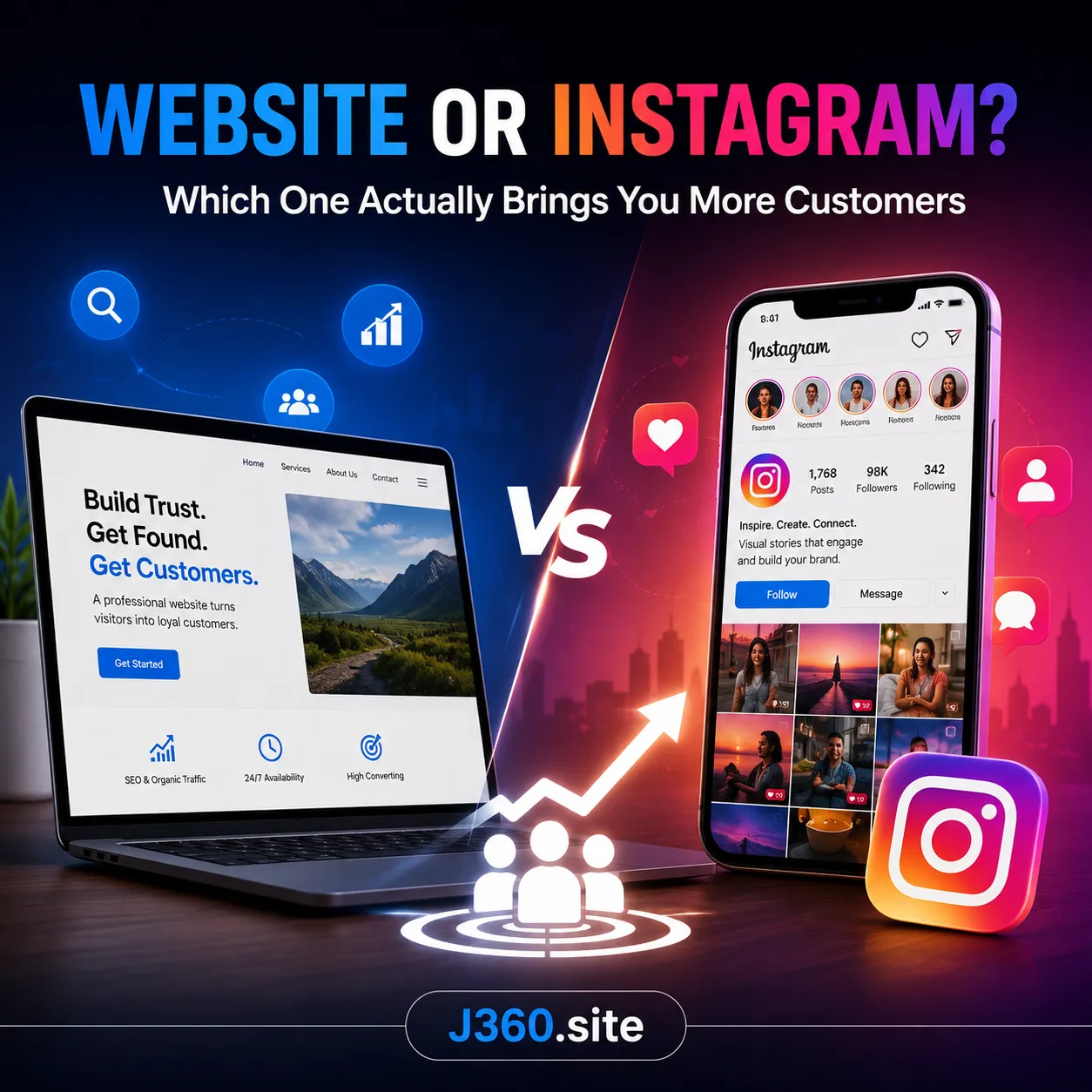
1.Introduction: The Real Battle for Customers in 2026
In today’s fast-moving digital landscape, getting attention is no longer the hardest part — turning attention into paying customers is. In 2026, businesses across the U.S. are facing a critical question: Where should you invest your time and money to actually grow your customer base — a website or Instagram?
At first glance, platforms like Instagram seem like the obvious choice. With millions of daily active users, instant visibility, and viral potential, it offers businesses a quick way to get in front of an audience. But there’s a catch: visibility does not equal conversion. You might get likes, follows, and even messages — but that doesn’t always translate into real revenue.
On the other hand, a well-optimized website acts as your digital headquarters — a place where you control the experience, build trust, and guide users toward taking action. Unlike social platforms, your website isn’t controlled by changing algorithms or limited reach. It’s where serious buyers go to validate your brand, explore your services, and make decisions.
The real battle in 2026 isn’t just about being seen — it’s about building trust, owning your audience, and converting traffic into customers. Businesses that understand this difference are the ones that consistently grow, while others stay stuck chasing engagement metrics that don’t impact their bottom line.
So before you invest more into content, ads, or growth strategies, it’s essential to understand one thing:
Are you building a real customer acquisition system — or just renting attention on someone else’s platform?
2.Why This Question Matters More Than Ever
In 2026, the way customers discover, evaluate, and choose businesses has changed dramatically. With increased competition, shorter attention spans, and smarter consumers, choosing the right platform for your online presence is no longer optional — it’s a critical business decision.
Today’s users don’t just scroll — they research, compare, and validate before making a purchase. This means that simply being active on Instagram is not enough. While it can help you get noticed, it often lacks the depth and structure needed to convince users to trust you and take action. That’s why businesses are starting to question where their real growth is coming from.
At the same time, customer acquisition costs are rising across all digital channels. Paid ads are more expensive, organic reach on social media is declining, and algorithms are constantly changing. Relying solely on a platform you don’t control puts your business at risk. One update can significantly reduce your visibility overnight. This makes it more important than ever to invest in assets you actually own, like your website.
Another key factor is trust. Modern customers are more skeptical than ever. Before they buy, they often search your brand on Google, check your website, read reviews, and look for credibility signals. If you don’t have a strong online presence beyond social media, you may be losing potential customers without even realizing it.
Ultimately, this question matters more than ever because it directly impacts your long-term growth, brand authority, and revenue stability. Businesses that make the right choice — or better yet, build the right combination — are the ones that will stand out, scale faster, and convert more customers in an increasingly competitive digital world.
3.What Instagram Does Best (And Where It Fails)
Instagram has become one of the most powerful platforms for capturing attention quickly. Its visual nature makes it ideal for showcasing products, telling brand stories, and building an emotional connection with your audience. Features like Reels, Stories, and Explore give businesses the opportunity to reach thousands — even millions — of users in a short amount of time. This makes Instagram a strong tool for brand awareness, engagement, and visibility.
One of Instagram’s biggest strengths is its ability to create instant interaction. Users can like, comment, share, and message your business within seconds. This creates a sense of accessibility and helps brands appear more human and relatable. For startups and small businesses, this can be a fast way to build an initial audience without a large budget.
However, despite these advantages, Instagram has significant limitations when it comes to turning attention into actual customers.
First, you don’t control the platform. Your reach is heavily dependent on the algorithm, which is constantly changing. One day your content performs well, and the next day your visibility drops — even if your content quality stays the same. This means your growth is unstable and unpredictable.
Second, Instagram is not designed for deep decision-making. Users are in a scrolling mindset, not a buying mindset. They consume content quickly and move on. There is limited space to explain your services, present detailed information, or guide users through a structured buying journey. As a result, converting followers into paying customers becomes much harder.
Another major limitation is lack of ownership. Your followers are not truly yours — if your account gets restricted, hacked, or loses reach, you lose access to your audience. Unlike a website or email list, you don’t have full control over your customer data or communication channels.
Finally, Instagram struggles with long-term growth and SEO. Content has a short lifespan, and posts quickly get buried under new content. There is no sustainable way to rank on search engines or generate consistent organic traffic over time.
In summary, Instagram is excellent for getting attention and building engagement, but it falls short when it comes to building trust, controlling your audience, and driving consistent conversions. Businesses that rely on it alone often find themselves stuck chasing visibility instead of building a reliable customer acquisition system.
4.What a Website Does Better Than Social Media
While social media platforms like Instagram are great for visibility, a website is where real business growth happens. A well-built website is not just an online presence — it’s a powerful customer acquisition system designed to attract, educate, and convert visitors into paying customers.
One of the biggest advantages of a website is full control. Unlike social media, where algorithms decide who sees your content, your website is 100% yours. You control the design, the messaging, the user journey, and most importantly, how you guide visitors toward taking action — whether that’s booking a service, making a purchase, or submitting a lead form.
Another major strength is credibility and trust. In the U.S. market, customers often judge a business based on its website. A professional, fast, and well-structured website instantly signals that your business is legitimate, established, and trustworthy. Without it, many potential customers may hesitate or choose a competitor who appears more credible.
Websites also excel at deep information delivery. Unlike Instagram, where content is short and quickly consumed, a website allows you to fully explain your services, showcase case studies, highlight testimonials, and answer customer questions in detail. This creates a stronger connection and helps users move from interest to decision.
From an SEO perspective, a website is unmatched. With the right strategy, your site can rank on Google and generate consistent, long-term organic traffic. This means customers can find you exactly when they are searching for your services — not just when they randomly come across your content. This type of traffic is highly valuable because it comes from users with high intent.
Another critical advantage is conversion optimization. A website can be designed specifically to maximize results using landing pages, call-to-action buttons, funnels, and data tracking. You can analyze user behavior, test different strategies, and continuously improve your performance — something that is very limited on social platforms.
Finally, a website gives you ownership of your audience and data. You can collect emails, build customer lists, and create direct communication channels that are not dependent on any third-party platform. This gives your business stability, scalability, and long-term security.
In short, while social media helps you get noticed, a website is what turns that attention into real, measurable business results. It’s not just a tool — it’s the foundation of your digital growth strategy.
5.Trust Factor: Where Do Customers Feel Safer Buying?
In today’s competitive digital market, trust is the ultimate deciding factor. No matter how good your product or service is, if customers don’t trust your brand, they simply won’t buy. This is especially true in the U.S., where users are more informed, cautious, and selective than ever before.
When customers discover a business on Instagram, their first reaction is often curiosity — not trust. Social media profiles can be created in minutes, and unfortunately, many users have experienced fake accounts, scams, or low-quality services. This has made people more skeptical. As a result, they rarely make purchasing decisions based solely on an Instagram page.
Instead, most users take the next step: they search your brand on Google. This is where the real trust-building process begins.
A professional website immediately creates a sense of credibility and legitimacy. When users land on a clean, well-designed site with clear messaging, real testimonials, detailed service pages, and secure browsing (HTTPS), they feel more confident. These elements act as trust signals that reassure visitors they are dealing with a serious business.
Websites also allow you to showcase social proof more effectively. Customer reviews, case studies, client logos, certifications, and detailed “About Us” pages all contribute to building confidence. This depth of information is something Instagram simply cannot provide in a structured and convincing way.
Another important factor is security perception. When it comes to making payments or sharing personal information, users feel significantly safer on a professional website than through direct messages on social media. Features like secure payment gateways, privacy policies, and clear contact information reduce friction and increase conversion rates.
Consistency across your online presence also plays a key role. When customers see your brand on Instagram and then visit a matching, high-quality website, it reinforces your brand authority. This consistency signals that your business is established and reliable, not temporary or experimental.
In contrast, relying only on Instagram can create doubt. Limited information, lack of structure, and dependency on DMs for communication can make your business feel less professional and harder to trust.
Ultimately, customers feel safer buying where they feel in control, informed, and secure. And in most cases, that place is your website. Instagram may spark interest, but your website is what builds trust and closes the deal.
6.Control & Ownership: You Don’t Own Your Instagram Audience
One of the biggest misconceptions in digital marketing is believing that your Instagram followers are truly “yours.” In reality, you are building your audience on rented land — a platform that you do not control. This means your business is always at the mercy of algorithms, policies, and platform decisions.
Instagram decides who sees your content, when they see it, and how often. Even if you have thousands of followers, only a small percentage may actually see your posts due to declining organic reach. This creates a major limitation: you’re constantly working to grow an audience that you can’t fully access or control.
Even more concerning is the risk factor. Accounts can be restricted, shadowbanned, hacked, or even permanently deleted — sometimes without warning. If that happens, you could instantly lose your connection to your entire audience. All the time, effort, and money you invested into building that following could disappear overnight.
Another key issue is lack of data ownership. On Instagram, you don’t have access to your audience’s contact information. You can’t build a reliable email list, segment your users, or create personalized communication strategies. Your only option is to hope they see your content or respond to your messages — which is far from reliable.
In contrast, a website gives you full ownership and control. You decide how your content is presented, how users interact with your brand, and how you capture leads. Through tools like contact forms, subscriptions, and analytics, you can build your own customer database — an asset that grows in value over time and is not dependent on any third-party platform.
This ownership allows you to create predictable and scalable growth systems. Instead of chasing engagement, you can build funnels, automate follow-ups, and nurture leads in a structured way. This is how real businesses grow — by turning traffic into owned audiences and long-term relationships.
Ultimately, the difference is simple but critical: Instagram gives you access to an audience, while a website gives you ownership of it. And in the long run, businesses that focus on ownership are the ones that achieve stability, security, and sustainable growth.
7.SEO vs Algorithm: Long-Term Traffic vs Temporary Visibility
One of the most important differences between a website and Instagram comes down to how you get traffic — and how long that traffic lasts. This is where the battle between SEO (Search Engine Optimization) and social media algorithms becomes critical for your business growth.
Instagram is driven by an algorithm-based system. Your content is shown to users based on engagement signals like likes, comments, shares, and watch time. While this can create quick bursts of visibility, the results are often short-lived. A post might perform well for 24–48 hours, but after that, it quickly disappears from users’ feeds. This means you’re constantly forced to create new content just to stay visible.
In contrast, SEO is built for long-term, sustainable traffic. When your website is properly optimized, it can rank on Google for relevant keywords and bring in visitors consistently over time — without needing constant posting. A single well-written article or optimized service page can generate traffic for months or even years.
Another key difference is user intent. On Instagram, users are typically browsing for entertainment or inspiration. They are in a passive mindset, not actively looking to buy. But on Google, users are searching with purpose. They type queries like “best web design agency in the U.S.” or “SEO services for small business,” which indicates high buying intent. This makes SEO traffic far more valuable and easier to convert.
Algorithms also create uncertainty. You are dependent on factors you can’t control — platform updates, content trends, and engagement patterns. This leads to inconsistent results and unpredictable growth. SEO, on the other hand, follows a more structured strategy. While it takes time to build, it provides stable and compounding results once your rankings improve.
Additionally, SEO allows you to target specific keywords and customer needs. You can create content that directly answers user questions, solves problems, and positions your business as an authority. This builds both visibility and trust at the same time — something social media struggles to achieve in a scalable way.
Ultimately, the difference is simple:
Instagram gives you temporary visibility, while SEO gives you long-term traffic and predictable growth.
Businesses that rely only on algorithms are always chasing attention. But businesses that invest in SEO are building a lasting digital asset that continues to generate leads and customers over time.
8.Conversion Power: Which One Actually Turns Visitors into Customers?
Getting traffic is important — but traffic alone doesn’t grow your business. What really matters is how effectively you can convert visitors into paying customers. This is where the difference between Instagram and a website becomes very clear.
Instagram is designed for engagement, not conversion. Users scroll quickly, consume content passively, and rarely stop to take a meaningful action. Even if someone is interested in your offer, the path to conversion is often unclear — they might need to visit your bio, click a link, navigate to another page, and then decide what to do next. Every extra step creates friction, and friction reduces conversions.
On top of that, Instagram limits how you present your offer. You don’t have full control over layout, structure, or user flow. This makes it difficult to guide users through a clear, strategic buying journey. As a result, many businesses end up with high engagement but low actual sales.
A website, on the other hand, is built specifically for conversion optimization. Every element — from the headline to the layout — can be designed with one goal in mind: getting the user to take action. You can create dedicated landing pages, highlight your value proposition, and place strong call-to-action (CTA) buttons exactly where they matter most.
Websites also allow you to reduce friction. With a clean structure, fast loading speed, and clear navigation, users can easily find what they need and move toward a decision. Features like one-click forms, booking systems, pricing sections, and FAQs help remove doubts and make the process smooth.
Another powerful advantage is the ability to track and improve performance. With tools like analytics, heatmaps, and A/B testing, you can see exactly how users behave on your site — where they click, where they drop off, and what drives conversions. This allows you to continuously optimize your funnel and increase results over time.
Trust also plays a major role in conversion. A professional website gives you the space to showcase testimonials, case studies, guarantees, and detailed service explanations, all of which increase confidence and push users closer to making a purchase.
Ultimately, conversion comes down to one thing: guidance. Instagram shows your content to users, but a website guides them step-by-step toward becoming a customer.
That’s why businesses that rely only on social media often struggle to scale, while those with a strong website build a predictable and high-converting system that turns traffic into real revenue.
9.Real Business Scenarios: When Instagram Works — and When It Doesn’t
Understanding when Instagram actually drives results—and when it becomes a waste of time and resources—is essential for building a profitable digital strategy. Not every business model performs well on Instagram, and knowing the difference can save you months of effort and budget.
When Instagram Works (High-Performance Scenarios)
Instagram delivers strong results when your business aligns with user behavior, content format, and buying psychology on the platform:
- Visual & Lifestyle Products
Businesses that rely on strong visuals—like fashion, beauty, fitness, food, and travel—thrive on Instagram. High-quality content can quickly capture attention and create emotional engagement, which leads to faster buying decisions. - Impulse & Low-Ticket Purchases
If your product doesn’t require deep research, Instagram can generate quick conversions. Users scroll, see, desire, and buy—often within minutes. - Personal Branding & Trust-Based Selling
Instagram is ideal for building trust through personality. Coaches, creators, and influencers can convert followers into customers by sharing authentic content, stories, and behind-the-scenes moments. - Engagement-Driven Growth Models
Brands that actively use Reels, Stories, Lives, and DMs can build strong relationships and increase audience loyalty, which directly impacts sales.
When Instagram Doesn’t Work (Low-ROI Scenarios)
In many cases, Instagram alone cannot support sustainable growth—especially when the business requires depth, trust, or high intent:
- High-Ticket or Complex Offers
Products or services that need detailed explanations, comparisons, or long decision-making processes (like SaaS, consulting, or B2B services) struggle on Instagram. The platform simply isn’t built for deep education. - Search-Driven Businesses
If your audience is actively searching for solutions on Google, relying only on Instagram means missing high-intent traffic. Instagram lacks strong search intent, which reduces conversion potential. - Lack of Audience Ownership
You don’t control your audience. Algorithm changes, account bans, or reach drops can instantly affect your visibility. This makes Instagram a risky standalone channel. - Inconsistent Visibility & Growth
Success depends heavily on algorithm performance and content virality. Without consistent reach, your business growth becomes unstable and unpredictable.
Real-World Strategy: Combining Instagram with a Conversion System
The most successful businesses use Instagram as part of a larger marketing ecosystem, not as the only channel:
- Use Instagram for attention, engagement, and brand awareness
- Direct users to a website or landing page for detailed information and conversion
- Capture leads through email lists or funnels to build long-term relationships
This creates:
- Short-term traffic spikes from social media
- Long-term, scalable revenue through owned platforms
Key Takeaway
Instagram works best when your business is:
- Visual, emotional, and fast-paced
It struggles when your business is:
- Complex, high-value, or research-driven
To succeed, you need to treat Instagram as a traffic and engagement tool—not your entire business foundation.
10.The Smart Strategy: Why You Shouldn’t Choose Just One
In today’s competitive digital landscape, choosing between Instagram or SEO is the wrong approach. The real growth happens when you combine both strategically. Each channel serves a different purpose, and relying on just one can limit your traffic, conversions, and long-term scalability.
Why Relying on One Channel Is Risky
Focusing only on a single platform—whether it’s Instagram or SEO—can create serious limitations:
- Platform Dependency
If you rely only on Instagram, your business is controlled by the algorithm, reach limitations, and sudden policy changes. If you depend only on SEO, growth may be slow in the beginning. - Missed Opportunities
Instagram captures attention and engagement, while SEO captures intent and demand. Ignoring one means losing a major source of potential customers. - Unstable Growth
A single-channel strategy often leads to inconsistent traffic and unpredictable revenue.
How Instagram and SEO Complement Each Other
Instead of choosing one, smart businesses build a multi-channel strategy where each platform plays a specific role:
- Instagram = Attention & Awareness
Use Instagram to attract users, build a brand, and create emotional connections through content like Reels, Stories, and posts. - SEO = Intent & Conversion
SEO brings users who are actively searching for solutions, making them more likely to convert into customers. - Content Synergy
You can repurpose content:- Turn blog posts into Instagram carousels or Reels
- Use Instagram to drive traffic to your website or landing pages
The Winning Funnel Strategy
A smart strategy connects both channels into a conversion-focused funnel:
- Attract → Use Instagram for visibility and engagement
- Redirect → Send users to your website or blog
- Convert → Use SEO-optimized content and landing pages to turn visitors into customers
- Retain → Capture emails or build remarketing audiences for long-term growth
This approach ensures:
- Consistent traffic flow
- Higher conversion rates
- Better audience ownership
Actionable Tips for Implementation
- Always include a clear call-to-action (CTA) in your Instagram content
- Link your audience to valuable, SEO-optimized pages
- Focus on building an email list or database to reduce dependency on platforms
- Track performance using analytics tools to optimize both channels
Final Takeaway
You don’t have to choose between Instagram and SEO. The smartest approach is to leverage both:
- Instagram for fast growth and engagement
- SEO for sustainable traffic and long-term revenue
When combined, they create a powerful, scalable, and resilient marketing system that protects your business from uncertainty and maximizes growth potential.
11.How Successful Businesses Combine Website + Instagram
Successful businesses don’t rely on just one channel—they build a strategic ecosystem where Instagram and their website work together to maximize traffic, trust, and conversions. This combination allows them to capture both attention-driven users and high-intent search traffic, creating a powerful and sustainable growth engine.
The Core Strategy: Traffic + Conversion System
Top-performing businesses clearly separate roles:
- Instagram = Traffic & Engagement Engine
They use Instagram to attract attention, build brand awareness, and engage users through visually appealing content. - Website = Conversion & Ownership Hub
Their website is designed to convert visitors into leads or customers using landing pages, blogs, and optimized funnels.
This structure ensures they don’t just get views—they get real, measurable business results.
Real Example Workflow Used by Successful Brands
Here’s how many successful brands operate:
- Create High-Engagement Content on Instagram
They publish Reels, carousels, and Stories to grab attention and trigger curiosity. - Drive Traffic to a Website or Landing Page
Every post includes a clear CTA (Call-To-Action) like:- “Learn more”
- “Read the full guide”
- “Shop now”
- Convert Through Optimized Pages
Once users land on the website, they see:- SEO-optimized content
- Clear product/service explanations
- Trust signals (reviews, testimonials, guarantees)
- Capture Leads for Long-Term Growth
Businesses collect emails via:- Free resources
- Discounts
- Lead magnets
This builds audience ownership, not just followers.
Why This Combination Works So Well
- Covers the Full Customer Journey
Instagram handles discovery, while the website handles decision-making and conversion. - Reduces Algorithm Risk
Even if Instagram reach drops, the business still gets consistent traffic from SEO and direct visitors. - Improves Conversion Rates
Websites provide more space, deeper information, and stronger trust-building elements, leading to better results than social media alone. - Builds Long-Term Assets
Unlike Instagram posts, SEO content becomes a long-term traffic source that keeps generating leads over time.
Key Tactics Used by Successful Businesses
- Use Instagram bio links to send users to high-converting landing pages
- Turn blog content into Instagram posts and short-form videos
- Retarget Instagram visitors using ads and email marketing
- Focus on building an email list, not just followers
- Continuously optimize website pages for SEO and conversions
Final Takeaway
The most successful businesses understand one key principle:
Instagram brings attention—but your website closes the deal.
By combining social media reach with SEO-driven conversion systems, they create a scalable, predictable, and high-performing marketing strategy that doesn’t rely on luck or algorithms alone.
12.Common Mistakes That Cost You Customers
Many businesses lose potential customers not because of a bad product, but بسبب strategic mistakes in their marketing and conversion process. Identifying and fixing these issues can dramatically improve your traffic quality, user experience, and conversion rate.
Relying Only on One Channel
One of the biggest mistakes is depending entirely on Instagram or SEO alone:
- Relying only on Instagram means your business is controlled by the algorithm and unpredictable reach
- Relying only on SEO can slow down your initial growth and visibility
Smart businesses diversify their traffic sources to ensure stability and consistent growth.
No Clear Conversion Path
Many brands attract visitors but fail to convert them due to lack of structure:
- No clear CTA (Call-To-Action)
- No defined sales funnel
- Weak or confusing landing pages
Without a clear path, users don’t know what to do next, and you lose potential customers.
Ignoring User Intent
Not all traffic is equal. A common mistake is targeting the wrong audience:
- Instagram users are often in discovery mode, not buying mode
- SEO users are usually in search and decision mode
Failing to match your content with user intent leads to low conversion rates and wasted effort.
Weak Trust Signals
If your brand doesn’t build trust, users won’t convert:
- No customer reviews or testimonials
- No clear brand identity or authority
- Poor or inconsistent content quality
Trust is a critical factor in buying decisions, especially for new visitors.
No Audience Ownership
Many businesses forget to build their own assets:
- No email list
- No lead capture system
- Full dependency on social platforms
This means you don’t control your audience, and any platform change can instantly impact your business.
Poor Website Experience
Even if you bring traffic, a weak website kills conversions:
- Slow loading speed
- Not mobile-friendly
- Confusing navigation
-
Lack of clear and sufficient information
A bad user experience leads to high bounce rates and lost sales opportunities.
Inconsistent Content Strategy
Posting randomly without a plan is another costly mistake:
- No content strategy
- No alignment between Instagram and website
- Lack of consistency in messaging
Consistency builds trust, recognition, and authority over time.
Final Takeaway
Most lost customers are the result of avoidable mistakes—not lack of effort.
To fix this:
- Build a multi-channel strategy
- Focus on conversion, not just traffic
- Create a clear, optimized user journey
- Invest in trust, content quality, and audience ownership
Eliminating these mistakes can turn your marketing from unpredictable and weak into a reliable, scalable system for growth.
13.How to Build a High-Converting Website (Without Wasting Money)
Building a website is easy—but building a high-converting website that actually turns visitors into customers is where most businesses fail. The key is not spending more money, but focusing on strategy, structure, and user experience. A smart approach helps you maximize results while keeping costs under control.
Start with a Clear Conversion Goal
Before designing anything, you need to define:
- What is the main goal of your website? (sales, leads, bookings)
- Who is your target audience?
- What action do you want users to take?
Without a clear goal, your website becomes just a digital brochure instead of a conversion tool.
Focus on Simple, Conversion-Driven Design
A high-converting website is not about fancy design—it’s about clarity:
- Use a clean and minimal layout
- Highlight your main offer clearly above the fold
- Add strong and visible Call-To-Action (CTA) buttons
- Avoid unnecessary elements that distract users
Simplicity increases conversions because users can quickly understand what to do.
Create High-Quality, SEO-Optimized Content
Your content should do two things: rank on Google and convert visitors:
- Use target keywords naturally
- Write clear and benefit-focused headlines
- Answer user questions with valuable, structured content
- Optimize pages for search intent, not just traffic
Good content brings consistent organic traffic and builds trust.
Build Trust with Strong Elements
Visitors won’t convert unless they trust you. Add:
- Customer testimonials and reviews
- Case studies or real results
- Trust badges, guarantees, or certifications
- Clear “About Us” and contact information
Trust signals reduce hesitation and increase conversion rates significantly.
Optimize for Mobile and Speed
Most users visit your site on mobile devices. If your website is slow or broken, you lose them instantly:
- Ensure mobile responsiveness
- Improve page loading speed
- Use optimized images and lightweight design
A fast, mobile-friendly site improves both SEO rankings and user experience.
Use a Smart Funnel Structure
Instead of random pages, build a conversion funnel:
- Landing Page → Introduce your offer
- Value Content → Educate and build trust
- CTA → Guide users toward action
- Follow-Up System → Email or retargeting
This structured flow increases the chances of turning visitors into paying customers.
Avoid Common Money-Wasting Mistakes
- Spending too much on design instead of strategy
- Ignoring SEO and relying only on ads
- Not testing or optimizing pages
- No clear conversion tracking
These mistakes lead to high costs with low results.
Final Takeaway
A high-converting website is built on strategy, not budget.
Focus on:
- Clear goals
- User-focused design
- SEO-driven content
- Trust-building elements
- Strong conversion funnels
When done right, your website becomes a powerful sales machine that works 24/7—without wasting money.
14.How jarvis360 Helps You Turn Traffic Into Real Customers
Getting traffic is only half the battle—what truly matters is turning that traffic into real paying customers. This is exactly where jarvis360 makes the difference. Instead of focusing only on generating visitors, jarvis360 builds a complete conversion system designed to transform every click into a real business opportunity.
From Traffic to Conversion: The jarvis360 Approach
jarvis360 uses a data-driven and conversion-focused strategy to connect every part of your marketing:
- Attract the right audience through SEO and targeted content
- Engage users through high-impact platforms like Instagram
- Convert visitors using optimized websites and high-performing landing pages
This creates a seamless journey from first interaction to final purchase.
What Makes jarvis360 Different?
jarvis360 focuses on what actually matters: results, revenue, and growth:
- Conversion-Optimized Websites
Websites built not just for looks, but for maximum conversions and lead generation - High-Intent SEO Strategy
Bringing in users who are actively searching and ready to take action—not just random traffic - Strategic Funnel Development
Creating a structured sales funnel that guides users step-by-step toward conversion - Integrated Marketing System
Connecting Instagram, SEO, and your website into one powerful and aligned system
How jarvis360 Increases Your Conversion Rate
jarvis360 focuses on the core elements that directly impact your results:
- Clear and compelling Call-To-Action (CTA)
- Strong trust signals (reviews, testimonials, authority)
- Fast, mobile-optimized user experience
- High-converting, SEO-optimized landing pages
All these components work together to turn passive visitors into engaged users and paying customers.
Stop Losing Customers — Start Converting Them
If you’re getting traffic but not seeing real results, the issue is not visibility—it’s conversion strategy.
With jarvis360, you can:
- Turn your website into a 24/7 sales engine
- Reduce reliance on unpredictable algorithms
- Build a scalable and sustainable growth system
Take Action Now
Don’t let your traffic go to waste.
Start building a conversion-focused system that actually drives revenue.
Work with jarvis360 to turn your traffic into real customers, consistent sales, and long-term growth.
15.Final Verdict: Website or Instagram — What Should You Focus On?
After comparing both channels, the real question is not “Website or Instagram?”—it’s how to use each one strategically to maximize growth, traffic, and conversions. Each platform plays a different role, and understanding that difference is the key to building a profitable and sustainable online presence.
Instagram: Best for Attention and Fast Growth
Instagram is powerful when your goal is:
- Building brand awareness quickly
- Creating engagement and audience connection
- Reaching new users through visual and viral content
However, it comes with limitations:
- You don’t fully own your audience
- Your reach depends on the algorithm
- Traffic and results can be inconsistent
Instagram is great for starting conversations—but not always closing sales.
Website: Best for Conversion and Long-Term Growth
A website is your most valuable digital asset when it comes to:
- Turning visitors into leads and customers
- Providing detailed information and building trust
- Generating consistent traffic through SEO
Unlike Instagram, your website gives you:
- Full control and ownership
- A stable, long-term traffic source
- Higher conversion potential
Your website is where real business happens.
The Real Answer: You Need Both
The smartest strategy is not choosing one—it’s combining both into a unified system:
- Use Instagram to attract attention and drive traffic
- Use your website to convert that traffic into customers
This combination allows you to:
- Capture both low-intent and high-intent users
- Build a complete customer journey
- Create a scalable and reliable growth system
What You Should Focus On First
If you’re just starting:
- Focus on building a simple but high-converting website
- Then use Instagram to drive traffic into that system
If you already have traffic:
- Optimize your website for better conversions
- Strengthen your content and SEO strategy
Final Takeaway
- Instagram brings visibility and engagement
- Your website delivers conversions and revenue
If you rely on only one, you limit your growth. But when you combine both, you create a powerful marketing engine that works together to generate traffic, trust, and consistent sales.
Don’t choose between them—build a system where both work together.