
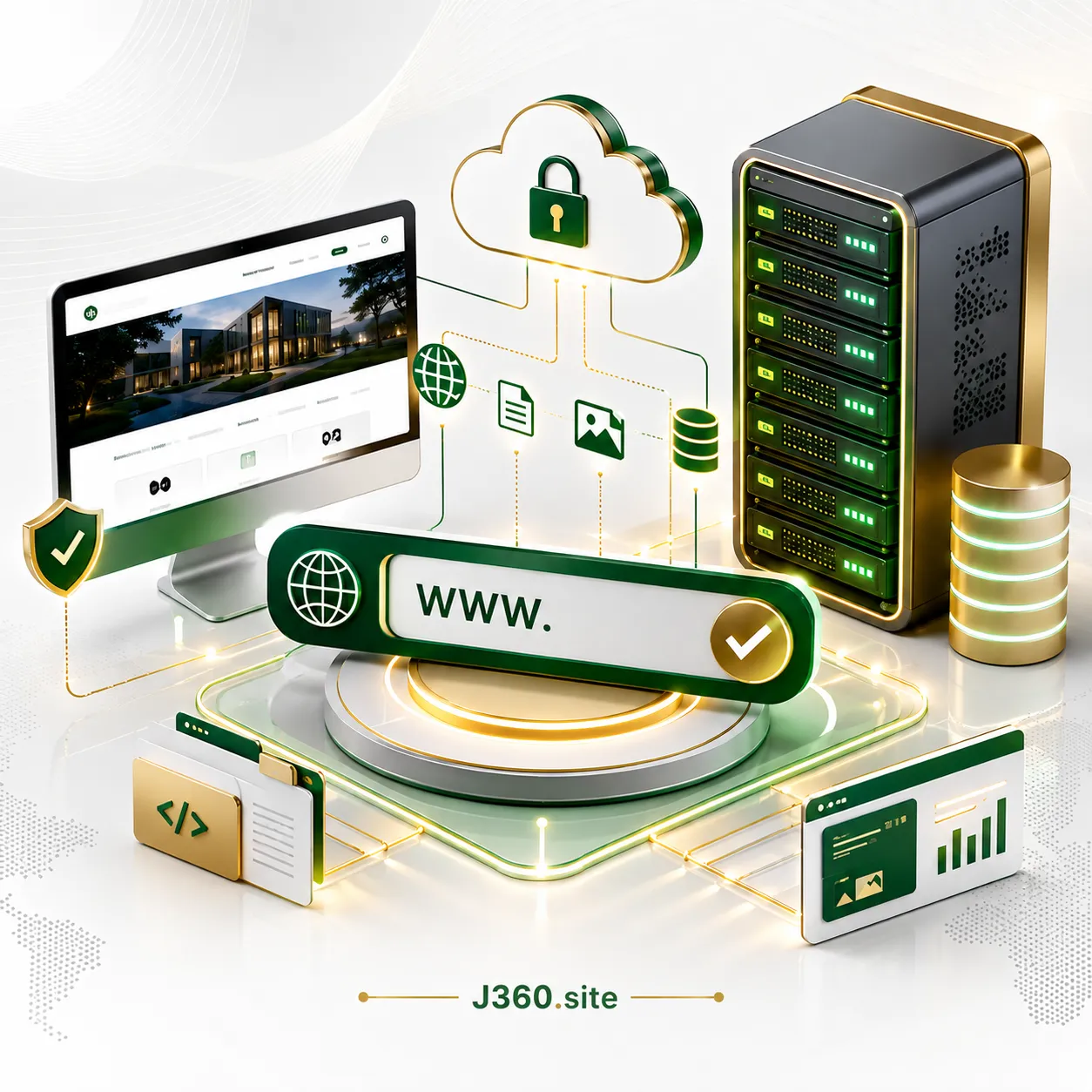
1.Introduction: Why Every Business Needs to Understand Hosting and Domains
In today’s digital world, having a website is no longer optional. Whether you run a small local business, an online store, a startup, or a large company, your website often creates the first impression of your brand.
However, many business owners focus only on the website’s design and completely overlook two of its most important components: web hosting and domain names.
Think of your website as a physical store.
Your domain name is your store’s address. It tells customers where to find you online. Your web hosting is the building where your store operates. It stores all of your website’s files, images, content, and databases and makes them accessible to visitors 24/7.
Without a domain, customers can’t find your website.
Without hosting, your website can’t exist on the internet.
Even though these concepts seem technical, understanding them doesn’t require any programming knowledge. In fact, every business owner should understand the basics of hosting, domains, website infrastructure, website security, and website performance.
Choosing the wrong hosting provider can lead to several problems, including:
- Slow website loading speeds
- Poor user experience
- Lower search engine rankings
- Frequent website downtime
- Security vulnerabilities
- Lost leads and potential customers
Similarly, choosing the wrong domain name can negatively affect your brand identity, credibility, and online visibility.
Many businesses invest thousands of dollars in website design, SEO, digital marketing, and advertising, but they fail to pay attention to the foundation of their online presence.
A beautiful website with poor hosting is like opening a luxury store in a building with no electricity.
This is why understanding hosting and domains is so important.
Throughout this guide, you’ll learn:
- What a domain name is
- What web hosting is
- How hosting and domains work together
- The different types of hosting
- How to choose the right hosting provider
- How hosting affects SEO and website speed
- The most common mistakes businesses should avoid
By the end of this article, you’ll have a clear understanding of how to build a strong digital foundation for your business and make smarter decisions when creating or improving your website.
2.What Is a Domain Name?
A domain name is the address of your website on the internet. Instead of entering a long and complicated IP address, users can simply type a memorable name into their browser to access your website.
Think of your website as a physical store. In this example, your domain name is your store’s address. Without an address, customers wouldn’t know where to find your business online.
A domain name usually consists of two parts:
- The brand name (such as J360)
- The domain extension (such as .com, .net, or .site)
For example:
J360.site
In this domain, J360 represents the brand, while .site is the extension.
A good domain name plays an important role in branding, marketing, and customer trust. It should be easy to remember, simple to spell, and closely related to your business.
When choosing a domain name, follow these best practices:
- Keep it short and simple.
- Avoid numbers and special characters.
- Choose a professional extension.
- Make sure it’s easy to pronounce and remember.
Your domain name isn’t just a website address. It’s a key part of your online identity and can directly influence how customers perceive your business.
Choosing the right domain is one of the first and most important steps in building a strong digital presence.
3.What Is Web Hosting?
Web hosting is a service that allows your website to be stored and accessed on the internet. Every website, from a small business page to a large e-commerce platform, needs hosting to be visible to visitors.
Think of your website as a house.
If your domain name is the address of that house, then web hosting is the land and building where everything is stored. Your website’s files, images, videos, databases, and content all live on a hosting server.
When someone enters your domain name into a browser, the hosting server delivers your website’s information and displays it on the user’s screen within seconds.
Without hosting, your website simply cannot exist online.
A hosting provider is responsible for keeping your website available 24 hours a day, 7 days a week. A good hosting service also provides important features such as:
- Fast loading speeds
- Website security
- Data backups
- High uptime
- Technical support
- Reliable performance
Many business owners choose the cheapest hosting option without considering its impact on their website. However, poor hosting can lead to slow loading times, security issues, lower search rankings, and a poor user experience.
Choosing the right hosting provider is an important investment because it directly affects your website’s performance, your SEO strategy, and your customers’ overall experience.
4.What’s the Difference Between a Domain and Web Hosting?
Many people think that a domain name and web hosting are the same thing, but they actually serve two completely different purposes.
A domain name is the address that people use to find your website, while web hosting is the service that stores your website’s files and makes them available on the internet.
The easiest way to understand the difference is to imagine your website as a physical business location:
- The domain name is your business address.
- Web hosting is the building where your business operates.
- Your website is everything inside that building, including products, images, and content.
For example, if someone types J360.site into a browser, the domain directs the visitor to the correct hosting server. The hosting server then loads the website and displays it on the screen.
Neither one can work effectively without the other.
You can purchase a domain and never build a website, or you can buy hosting without connecting a domain. However, if you want a fully functional website, you need both.
| Domain Name | Web Hosting |
| Website address | Website storage |
| Helps users find your website | Stores website files |
| Used for branding | Used for performance |
| Purchased through a domain registrar | Purchased through a hosting provider |
Understanding the difference between these two services will help you make better decisions when creating or managing your business website.
5.How Does a Website Actually Work? (A Simple Explanation)
Many business owners think that a website is simply a collection of pages and images, but several technologies work together behind the scenes to make a website accessible to users.
The process is actually much simpler than it sounds.
When someone types your website address into a browser, four basic steps happen:
- The user enters your domain name.
For example, a customer types J360.site into their browser.
- The Domain Name System (DNS) finds your website.
The DNS translates your domain name into the correct IP address and directs the visitor to the appropriate server.
- The hosting server receives the request.
Your hosting provider stores all of your website’s files, including text, images, videos, databases, and code.
- The website appears on the user’s screen.
The server sends the requested information to the browser, and your website loads within a few seconds.
The process can be summarized like this:
Visitor → Domain Name → DNS → Hosting Server → Website
Several elements work together to keep a website running smoothly, including:
- Domain name
- DNS
- Web hosting
- Website files
- Web browser
If even one of these components stops working, your website may become inaccessible.
This is why choosing a reliable hosting provider and a professional domain name is so important. They create the foundation of your online presence and directly affect your website’s speed, security, performance, and user experience.
6.Different Types of Web Hosting Explained
Not all hosting services are the same. Choosing the right type of hosting can affect your website’s speed, security, scalability, and overall performance.
The best hosting option depends on your business goals, website traffic, and budget. Here are the four most common types of web hosting.
Shared Hosting
Shared hosting is the most affordable option for beginners and small businesses. Multiple websites share the same server and its resources.
Best for:
- Small business websites
- Personal websites
- New businesses
Advantages:
- Lower cost
- Easy to manage
- Beginner-friendly
VPS Hosting
A Virtual Private Server (VPS) provides dedicated resources within a shared environment. It offers better performance and greater control than shared hosting.
Best for:
- Growing businesses
- Medium-sized websites
- Businesses with increasing traffic
Advantages:
- Better performance
- More flexibility
- Improved security
Dedicated Hosting
With dedicated hosting, an entire server is reserved for a single website. This option delivers maximum performance and complete control.
Best for:
- Large businesses
- High-traffic websites
- Enterprise websites
Advantages:
- Maximum speed
- Complete server control
- Excellent performance
Cloud Hosting
Cloud hosting uses multiple connected servers instead of relying on a single physical server. If one server fails, another server automatically takes over.
Best for:
- Fast-growing businesses
- E-commerce websites
- Websites with fluctuating traffic
Advantages:
- High reliability
- Excellent scalability
- Better uptime
There is no single hosting solution that works for every business. The right choice depends on your website’s needs, expected traffic, and long-term growth plans. Choosing the appropriate hosting type can help create a faster, more secure, and more reliable website.
7.How to Choose the Right Domain Name for Your Business
Choosing the right domain name is one of the most important decisions you’ll make when building a website. Your domain represents your brand and often creates the first impression for potential customers.
A good domain name should be simple, memorable, and professional. If people can’t remember or spell your domain correctly, they may have difficulty finding your website.
When selecting a domain name, follow these best practices:
- Keep it short and easy to remember
- Choose a name that reflects your brand or industry
- Avoid numbers and unnecessary symbols
- Make it easy to spell and pronounce
- Select a professional domain extension
For most businesses, .com is still the most popular and trusted domain extension. However, extensions such as .net, .co, .io, and .site can also be excellent choices.
Before registering a domain, ask yourself these questions:
- Does it match my brand?
- Is it easy to remember?
- Is it easy to type?
- Will it still represent my business in the future?
Your domain name will appear in your website address, email accounts, marketing campaigns, and search results. That’s why choosing the right domain is an important part of building a strong online presence and brand identity.
8.How to Choose the Best Hosting Provider
Choosing the right hosting provider is just as important as choosing the right domain name. A reliable hosting company can improve your website’s speed, security, SEO performance, and user experience, while a poor provider can create serious problems for your business.
Many business owners make the mistake of choosing the cheapest option. However, price shouldn’t be the only factor in your decision.
Before selecting a hosting provider, pay attention to these important factors:
Website Speed
A fast website creates a better user experience and can improve your search engine rankings. Slow websites often have higher bounce rates and lower conversion rates.
Uptime Guarantee
Uptime refers to the amount of time your website remains available online. Look for a provider that offers at least 99.9% uptime.
Security Features
Your hosting provider should offer essential security features, including:
- SSL certificates
- Automatic backups
- Malware protection
- Firewall security
Customer Support
Technical problems can happen at any time. That’s why 24/7 customer support is extremely important.
Scalability
Your business will grow over time, and your hosting should be able to grow with it. Choose a provider that allows you to upgrade your hosting plan as your website traffic increases.
Before making a final decision, compare several hosting companies and read customer reviews. The best hosting provider isn’t always the cheapest one. It’s the provider that offers the right combination of performance, reliability, security, and support for your business.
9.The Most Common Hosting and Domain Mistakes Businesses Make
Choosing a domain name and a hosting provider may seem simple, but many businesses make costly mistakes during this process. These mistakes can negatively affect website performance, SEO, security, and customer experience.
One of the most common mistakes is choosing a domain name that is too long or difficult to remember. A complicated domain can make it harder for customers to find your website and remember your brand.
Another common mistake is selecting hosting based only on price. Cheap hosting plans often come with limited resources, slower performance, and weaker security.
Businesses should also avoid these mistakes:
- Choosing a domain name that doesn’t match the brand
- Ignoring website security
- Purchasing more hosting resources than necessary
- Forgetting to renew a domain name
- Choosing a hosting provider without reliable customer support
- Ignoring backup and recovery options
Some businesses also register their domain and hosting through different companies without properly managing their account information. This can create technical problems when it’s time to update or transfer a website.
Investing a little more time in research can help you avoid these common mistakes and build a website that is faster, safer, and better prepared for long-term growth.
10.Which Domain Extensions Should You Choose? (.com, .net, .org, and More)
Choosing the right domain extension is an important part of building your online presence. A domain extension, also known as a Top-Level Domain (TLD), is the part that appears after your website name, such as .com or .net.
Today, there are hundreds of domain extensions available, but not all of them are suitable for every business.
Here are some of the most common domain extensions:
- .com – The most popular and trusted option for businesses.
- .net – Originally created for networking companies but now used by many different websites.
- .org – Commonly used by non-profit organizations and communities.
- .co – A modern alternative often used by startups and small businesses.
- .io – A popular choice for technology and software companies.
- .ai – Frequently used by businesses that focus on artificial intelligence.
For most businesses, .com is still the best option because it’s familiar, professional, and easy for customers to remember. However, if your preferred .com domain isn’t available, other extensions can also work well.
When choosing a domain extension, consider these factors:
- Your industry
- Your target audience
- Your brand identity
- Your long-term business goals
Remember that a domain extension won’t automatically improve your SEO rankings. Search engines focus more on content quality, website performance, and user experience than on the extension itself.
The most important thing is to choose a domain that supports your brand and makes it easy for customers to find and trust your business.
11.How Hosting Affects Website Speed, SEO, and User Experience
Many business owners think that hosting is simply a place to store a website, but it has a much bigger impact than most people realize. Your hosting provider directly affects your website’s speed, SEO performance, and user experience.
Website Speed
Speed is one of the most important factors in a successful website. Modern users expect a website to load quickly, and even a few extra seconds can increase the chances of visitors leaving your site.
Poor hosting can cause:
- Slow page loading
- Server errors
- Delayed responses
- Higher bounce rates
A fast website creates a better experience for users and increases the likelihood that visitors will stay on your site longer.
SEO Performance
Search engines such as Google consider website speed when ranking pages. While hosting isn’t the only ranking factor, it plays an important role in your overall SEO strategy.
High-quality hosting can improve:
- Website speed
- Website uptime
- Security
- Mobile performance
- Core Web Vitals
On the other hand, slow or unreliable hosting can negatively affect your search rankings and reduce your website’s visibility.
User Experience
User experience refers to how visitors interact with your website. A website that loads quickly and works properly creates a positive impression and encourages visitors to explore more pages.
Poor hosting can lead to:
- Broken pages
- Frequent downtime
- Slow navigation
- Frustrated visitors
These problems can reduce customer trust and make it more difficult to convert visitors into paying customers.
Choosing a reliable hosting provider isn’t just a technical decision. It’s a business decision that can directly influence your traffic, conversions, customer satisfaction, and long-term growth.
12.Can You Change Your Hosting Provider or Domain Later?
Yes, you can change your hosting provider or domain name at any time. However, making these changes requires careful planning to avoid technical problems that could affect your website.
Many businesses decide to switch their hosting provider because they need:
- Better website performance
- Faster loading speeds
- Stronger security
- More storage and resources
- Better customer support
Moving to a new hosting provider is usually a straightforward process. Most hosting companies offer website migration services that help transfer your files, databases, and website settings with minimal downtime.
Changing a domain name is also possible, but it’s often more complicated. Your domain is closely connected to your brand identity, email addresses, backlinks, and SEO strategy.
Before changing your domain name, consider the following questions:
- Will customers still recognize my brand?
- Will I lose traffic from search engines?
- Have I updated all of my marketing materials?
- Have I redirected my old URLs to the new domain?
If you decide to change your domain, it’s important to use 301 redirects to send visitors and search engines from the old website address to the new one. This helps protect your existing SEO value.
The good news is that neither your hosting provider nor your domain name is permanent. As your business grows, you can always upgrade your hosting plan or move your website to a better solution that supports your long-term goals.
13.How Jarvis360 Helps Businesses Build Fast, SEO-Friendly Websites
Choosing the right hosting provider and domain name is only the first step. Building a successful website requires much more than simply purchasing a domain and uploading a few pages.
At Jarvis360, we help businesses create professional, high-performance websites that are designed to support long-term growth. Our goal is to build websites that not only look great but also deliver an excellent user experience.
Our services include:
- Website design and development
- Search Engine Optimization (SEO)
- Website performance optimization
- AI-powered digital solutions
- Technical website consulting
We understand that every business has different goals. That’s why we focus on creating customized solutions that improve website speed, search visibility, and conversion rates.
A fast, secure, and well-optimized website can help businesses:
- Attract more visitors
- Improve search engine rankings
- Increase customer engagement
- Generate more leads
- Build stronger brand credibility
Whether you’re launching your first website or upgrading an existing one, choosing the right digital strategy can make a significant difference.
At Jarvis360, we believe that a website should be more than an online brochure. It should become a powerful tool that helps your business grow in an increasingly competitive digital world.
14.Conclusion: Choosing the Right Foundation for Your Business Website
Building a website isn’t just about choosing a beautiful design. The foundation of every successful website begins with two essential elements: a domain name and a reliable hosting provider.
Your domain name helps customers find your business online, while web hosting keeps your website accessible, secure, and running smoothly. Understanding the difference between these two components can help you make smarter decisions when creating or managing your website.
Choosing the right hosting and domain can improve your:
- Website speed
- SEO performance
- User experience
- Website security
- Brand credibility
Even if you don’t have a technical background, learning these basic concepts can help you avoid common mistakes and build a stronger online presence.
Remember, your website is often the first interaction customers have with your business. Investing in the right foundation today can support your company’s growth for years to come.