
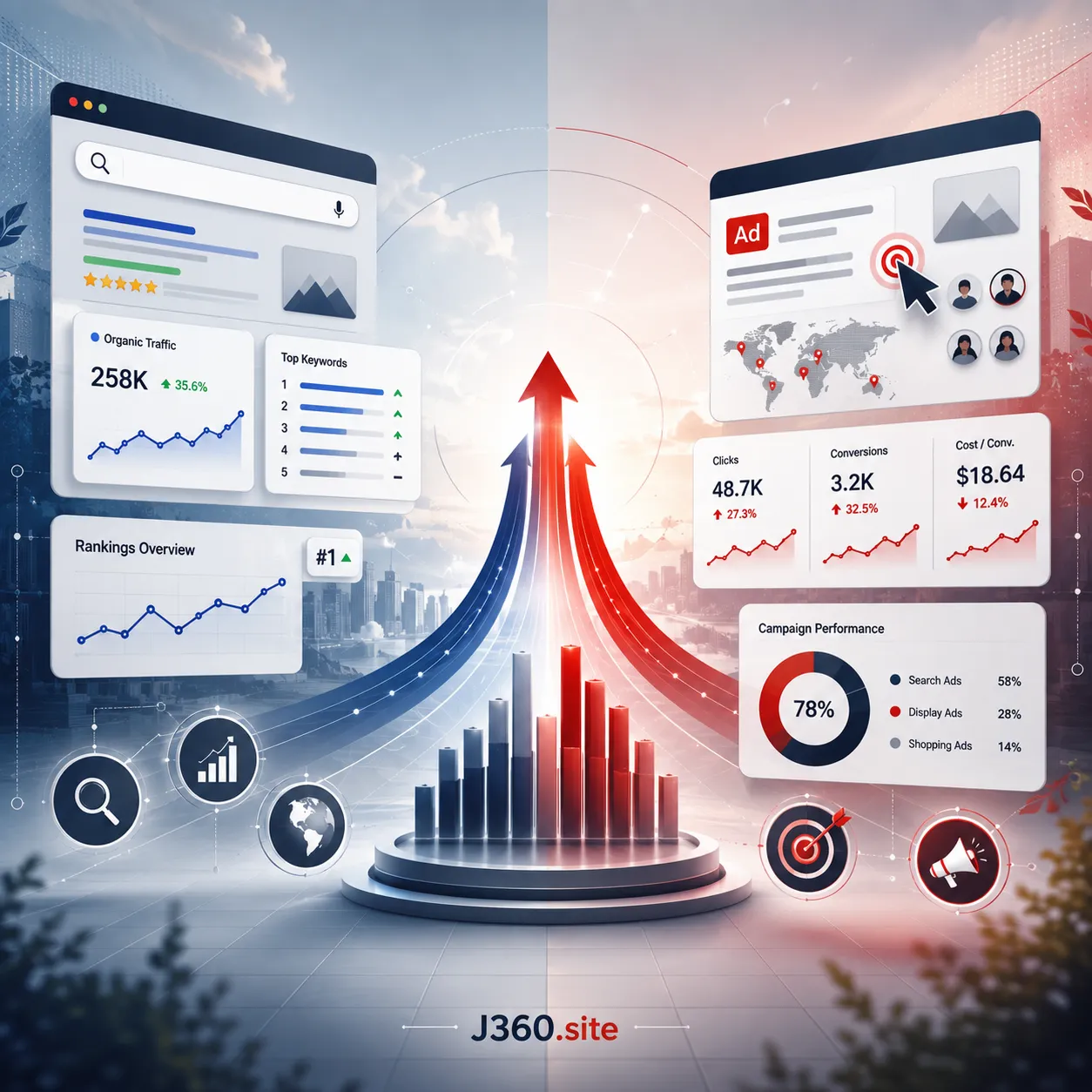
1. Introduction: Choosing the Right Path to Online Growth
In today’s competitive digital landscape, having a strong online presence is essential for businesses that want to attract new customers, generate leads, and achieve sustainable growth. However, simply having a website is not enough. Businesses need effective strategies to make their websites visible to the right audience at the right time.
SEO vs Paid Ads is a common question for businesses deciding how to invest in their digital marketing strategy. Two of the most powerful channels for increasing online visibility are Search Engine Optimization (SEO) and paid advertising. SEO helps businesses build organic visibility in search engine results by improving website content, technical performance, and authority. Paid advertising, including PPC campaigns, provides businesses with the opportunity to reach targeted audiences quickly and generate immediate traffic.
While both strategies can support business growth, they work in very different ways. SEO is generally a long-term investment, while paid ads can provide faster visibility and measurable results. The right choice depends on factors such as your business goals, budget, target audience, industry, competition, and growth timeline.
In this guide, we’ll explore SEO vs Paid Ads, how each strategy works, what they cost, how quickly they can produce results, and when each approach makes the most sense. We’ll also look at why combining both channels can create a stronger digital marketing strategy and help businesses build a more sustainable path to online growth.
2.SEO and Paid Advertising: How They Actually Work
SEO and paid advertising are two different approaches to increasing a business’s visibility in search engines, but they operate in very different ways. Understanding how each one works makes it easier to decide which strategy is best suited to your business goals.
How SEO Works
Search Engine Optimization (SEO) focuses on improving a website’s ability to appear in organic search results. Instead of paying for every click, businesses optimize their websites to provide valuable content and a better experience for both users and search engines.
An effective SEO strategy can include keyword research, content creation, on-page optimization, technical SEO, internal linking, website performance improvements, and link building. These efforts help search engines understand a website’s content, relevance, and authority.
When a website earns strong organic rankings for valuable search terms, it can attract a consistent stream of qualified organic traffic. However, SEO is generally a long-term strategy and requires ongoing optimization, especially in competitive markets.
How Paid Advertising Works
Paid advertising, commonly known as PPC (Pay-Per-Click), allows businesses to pay for prominent placements on search engines and other digital platforms. With platforms such as Google Ads, businesses can target specific keywords, locations, audiences, and search behaviors.
When someone searches for a relevant keyword, an advertiser may have the opportunity to display an ad near the top of the search results. Businesses typically pay when users interact with their ads, depending on the campaign and advertising model.
One of the biggest advantages of paid advertising is speed and control. Businesses can set budgets, define target audiences, test different messages, and quickly measure results such as clicks, leads, conversions, and return on ad spend (ROAS).
The Key Difference Between the Two
The fundamental difference is how each channel generates visibility. SEO builds organic visibility over time, while paid advertising purchases immediate visibility through advertising platforms.
SEO can create long-term value by building website authority, organic rankings, and sustainable traffic. Paid advertising provides more immediate access to potential customers but requires ongoing investment to maintain visibility.
For this reason, the two strategies should not always be viewed as competitors. SEO can build the foundation for long-term growth, while paid advertising can capture immediate demand and provide valuable performance data. Understanding how both channels work allows businesses to create a more flexible and effective digital marketing strategy.
3.What Does Each Strategy Cost Over Time?
Understanding the long-term cost of SEO and paid advertising is essential when deciding where to invest your marketing budget. The cheapest option at the beginning is not always the most cost-effective over time. Businesses should consider not only how much they spend, but also how much traffic, leads, conversions, and revenue each strategy can generate.
The Investment Behind SEO
SEO requires an ongoing investment in activities such as keyword research, content creation, technical optimization, website improvements, and link building. Depending on the competitiveness of the industry, businesses may also need to invest in professional SEO specialists or agencies to maintain and improve their search visibility.
The important difference is that businesses generally do not pay a search engine for every organic click. As a website gains authority and ranks for valuable keywords, existing SEO work can continue generating organic traffic and leads over time.
This means SEO can become increasingly cost-effective as rankings improve. A high-quality page that ranks well can continue attracting potential customers without requiring a separate advertising payment for every visitor.
The Ongoing Cost of Paid Advertising
Paid advertising works differently because businesses need to maintain an advertising budget to keep their campaigns active. Costs can depend on factors such as keyword competition, audience targeting, industry, ad quality, and campaign objectives.
The major advantage is that paid ads provide greater control and faster visibility. Businesses can decide how much to spend, which audiences to target, and when campaigns should run. However, when the budget is paused, the traffic generated directly from those campaigns generally decreases as well.
For competitive industries, rising cost-per-click (CPC) can also make paid advertising more expensive over time. This makes campaign optimization, conversion tracking, and landing page performance especially important.
Looking Beyond the Initial Cost
Comparing SEO and paid ads based only on monthly spending can be misleading. A better approach is to evaluate customer acquisition cost (CAC), conversion rate, cost per lead, revenue, and return on investment (ROI).
SEO may require more patience before producing significant results, but it can create lasting organic visibility. Paid advertising may require continuous spending, but it can provide immediate traffic and measurable results.
For many businesses, the most cost-effective strategy is a balanced marketing mix. Investing in SEO can build long-term organic growth, while paid advertising can generate immediate opportunities and help test keywords, audiences, and offers. The right combination depends on your goals, budget, competition, and expected return.
4.How Quickly Can You Expect Results?
One of the biggest differences between SEO and paid advertising is how quickly each strategy can produce results. Businesses often want to know when they can expect more traffic, leads, or sales after investing in digital marketing. The answer depends on the strategy, competition, website condition, budget, and quality of execution.
How Long Does SEO Take to Work?
SEO is a long-term growth strategy, so businesses should not expect significant organic results overnight. Search engines need time to crawl and evaluate website changes, understand new content, and determine how a website compares with competing pages.
The timeline can vary significantly. Factors such as domain authority, keyword competition, technical SEO, content quality, backlinks, website history, and search intent can all influence how quickly rankings improve.
While SEO may take longer to gain momentum, its value can increase over time. Once important pages achieve strong organic rankings, they can continue attracting qualified organic traffic, leads, and potential customers without requiring payment for every click.
How Quickly Can Paid Ads Produce Results?
Paid advertising generally provides much faster visibility. Once a campaign is properly configured, approved, and launched, businesses can begin appearing in front of relevant audiences and generating clicks, leads, and conversions.
This makes PPC especially useful for businesses that need immediate traffic, are launching a new product, promoting a limited-time offer, or testing a new market. However, launching an ad campaign does not automatically mean it will be profitable. Targeting, ad copy, landing page quality, conversion tracking, and budget management all influence performance.
Speed vs. Long-Term Value
The important question is not simply which strategy produces results faster, but what type of results your business needs. Paid ads can provide immediate opportunities, while SEO can build a sustainable source of organic traffic over a longer period.
For businesses that need fast customer acquisition, paid advertising can be an effective starting point. For businesses focused on long-term visibility, organic growth, and sustainable customer acquisition, SEO is worth building alongside those short-term campaigns.
In many cases, the smartest approach is to use paid ads for immediate visibility while developing SEO in parallel. This allows businesses to generate opportunities today while building an organic growth channel that can deliver increasing value over time.
5.When Is SEO the Better Investment?
SEO is often the better investment for businesses focused on long-term growth, sustainable traffic, and stronger online visibility. While paid advertising can deliver immediate exposure, SEO helps build an organic presence that can continue generating value over time. The right choice depends on how your business acquires customers and what you want your digital marketing strategy to achieve.
When You Want Sustainable Organic Traffic
If your goal is to build a consistent source of organic traffic, SEO can be a strong long-term investment. By targeting relevant keywords and creating useful content, businesses can attract potential customers who are actively searching for their products, services, or solutions.
Unlike paid campaigns, organic traffic does not require paying for every individual click. Once important pages establish strong rankings, they can continue bringing visitors to your website and supporting lead generation over an extended period.
When Your Customers Use Search Engines to Find Solutions
SEO is particularly valuable when your target audience relies on Google and other search engines during the buying journey. Whether users are researching a problem, comparing providers, or looking for a specific service, appearing in relevant organic results can put your business in front of customers with genuine search intent.
For service-based businesses, local companies, B2B organizations, and e-commerce brands, a strong search presence can become an important source of qualified leads and sales.
When You Want to Build Brand Authority
SEO is not only about rankings and traffic. Consistently publishing helpful, trustworthy, and relevant content can establish your business as an authority within its industry.
Educational articles, detailed service pages, guides, FAQs, and case studies can answer customer questions while demonstrating your expertise. Over time, this can strengthen brand credibility and customer trust.
When You Are Focused on Long-Term ROI
SEO makes the most sense when your business is prepared to invest in long-term results rather than immediate returns. Building organic visibility takes time and requires ongoing optimization, but successful rankings can continue generating traffic without the same direct cost associated with every paid click.
For businesses looking to reduce their dependence on advertising spend, SEO can also provide a valuable additional acquisition channel. Instead of relying entirely on paid traffic, companies can gradually build organic visibility, website authority, and sustainable customer acquisition.
Ultimately, SEO is a strong choice when your priority is to build a digital presence that becomes more valuable over time. It may require patience, but for businesses with a long-term growth mindset, SEO can become one of the most sustainable sources of online traffic and leads.
6.When Do Paid Ads Make More Sense?
Paid advertising makes the most sense when a business needs fast visibility%2